
Aperture is far more than a physical opening that regulates how bright an image is. In optical physics and visual storytelling, the aperture diaphragm controls depth of field, spatial separation, optical aberrations, transmission efficiency, and the rendering characteristics of out-of-focus light elements (bokeh).
Mastering aperture requires looking beyond simple numbers on a camera dial to understand how lens geometry, ray optics, and sensor planes interact.
1. The Anatomy of an Aperture: The Iris Diaphragm
Inside an optical lens assembly sits the iris diaphragm—an adjustable mechanical construct composed of overlapping curved metal blades.
- The Entrance Pupil: When you look into the front element of a camera lens, the apparent size of the diaphragm opening you see is the entrance pupil. It is the optical image of the physical aperture stop as viewed through the front lens elements.
- Light Transmission: Widening the entrance pupil allows a larger cone of light rays to enter the optical path and converge onto the sensor plane, increasing exposure value (+EV). Closing down (stopping down) restricts this cone, reducing the photon density that reaches the photodiodes.
2. The Mathematics of F-Stops: The Sequence
The term f-stop represents a geometric ratio rather than a fixed physical measurement in millimetres:
F-Stop Number (N) = Focal Length (f) / Diameter of Entrance Pupil (D)
Because light intensity is proportional to the surface area of the circular entrance pupil, halving or doubling the light gathering capacity requires changing the aperture diameter by a factor of .
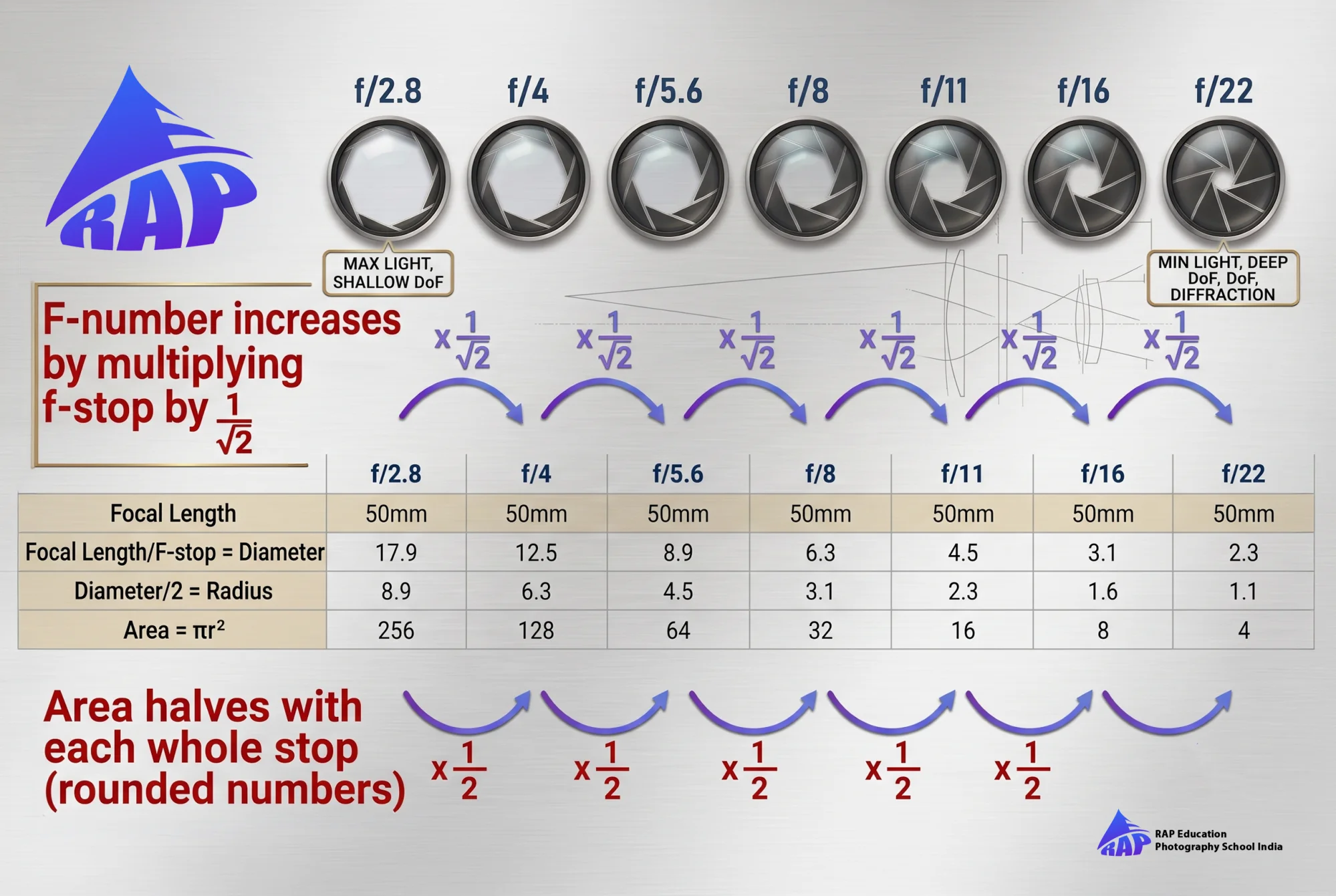
The Standard Full-Stop Aperture Scale:
- f/1.4 → f/2.0 → f/2.8 → f/4.0 → f/5.6 → f/8.0 → f/11 → f/16 → f/22
Each step to the right cuts the amount of light entering the sensor by exactly 50% (-1 EV). Conversely, each step to the left doubles the light volume (+1 EV).
- Example: A 50mm lens at f/2.0 requires an entrance pupil diameter of . At f/4.0, the diameter drops to , shrinking the circular area to one-quarter of its previous size.
3. Depth of Field (DoF) & The Circle of Confusion
Depth of Field (DoF) is the optical zone in front of and behind the precise plane of focus where subjects appear acceptably sharp to the human eye.
What Determines Depth of Field?
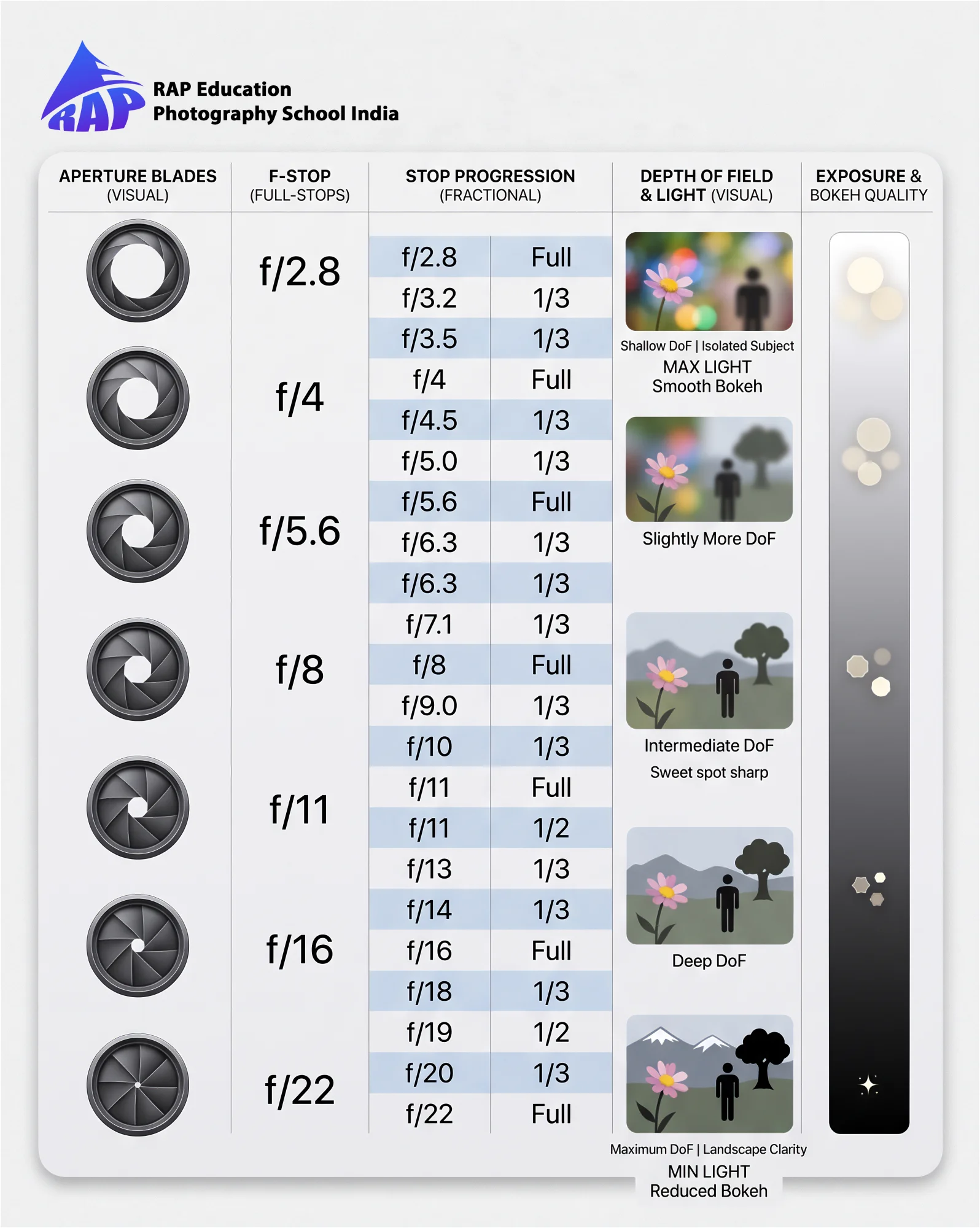
- Aperture Diameter: Wide apertures (such as f/1.2, f/1.4, f/1.8) produce a narrow cone of light that diverges rapidly from the focal plane, creating a shallow depth of field. Narrow apertures (such as f/8, f/11) produce a steep, slender light cone, expanding the zone of sharpness across the scene.
- Subject Distance: The closer the camera is positioned to the focal plane, the shallower the depth of field becomes (most noticeable in macro and close-up portraiture).
- Focal Length: Longer focal lengths (e.g., 85mm, 135mm, 200mm) produce significant subject-background compression, accentuating shallow depth of field compared to wide-angle focal lengths (e.g., 24mm, 35mm).
- Circle of Confusion (CoC): Light rays from an out-of-focus point converge into a circular blur spot rather than a pinpoint dot on the sensor. As long as this blur spot remains smaller than the sensor’s resolution threshold and the human eye's resolving capacity, the image is perceived as sharp.
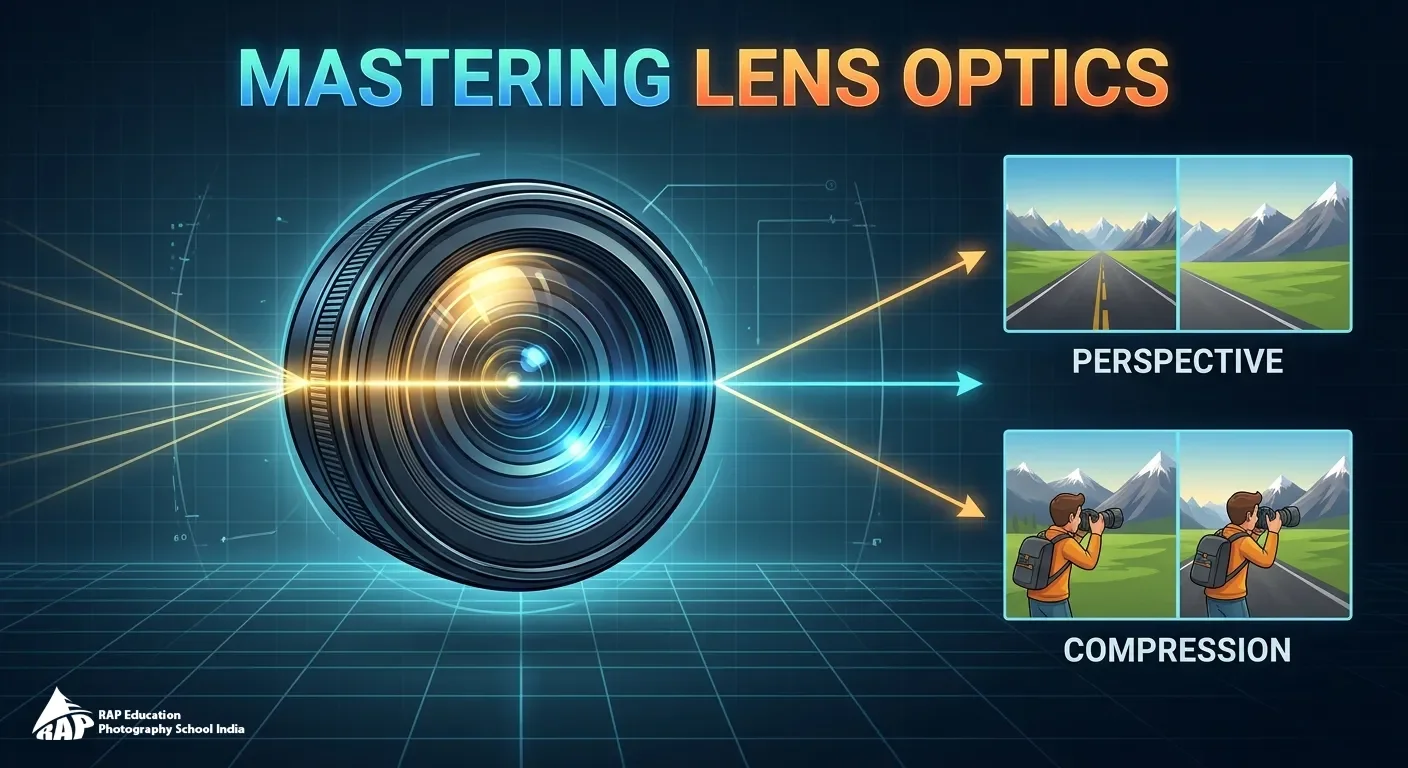
To understand how focal lengths compress background elements, explore our complete guide on Mastering Lens Optics & Focal Length.
4. The Optical Diffraction Barrier & Lens "Sweet Spots"
A common beginner mistake is stopping a lens down all the way to f/22 in pursuit of absolute, edge-to-edge sharpness. In physical optics, this results in the exact opposite due to wave diffraction.
The Physics of Diffraction:
When light waves squeeze through an extremely small aperture opening (such as f/16 or f/22), they bend around the sharp edges of the aperture blades and interfere with one another, forming concentric interference rings known as Airy Discs.
- When these Airy discs expand and overlap adjacent photodiodes on a high-resolution sensor, optical contrast and fine micro-detail are compromised across the entire frame.
- The Lens Sweet Spot: Most professional prime and zoom lenses deliver their peak optical resolution, micro-contrast, and minimal chromatic aberration between f/4.0 and f/8.0.
5. F-Stops vs. T-Stops in Cinematography
In commercial cinematography, optical exposure precision is paramount:
- F-Stop (Geometric Aperture): A theoretical mathematical ratio of focal length to physical pupil diameter. It does not account for light loss caused by glass element absorption and internal reflections.
- T-Stop (Transmission Stop): A photometric measurement of true light transmission through the complete lens barrel:
- T-Stop = F-Stop /
A cinema lens marked at T2.0 guarantees the exact same light volume reaches the sensor regardless of whether you shoot on an ultra-wide 18mm or a 135mm telephoto cinema prime, eliminating exposure shifts when switching focal lengths between takes.
6. Bokeh Aesthetics & Diaphragm Blade Engineering
Bokeh refers to the subjective aesthetic quality of the out-of-focus blur:
- Blade Count & Curvature: Budget lenses with 6 or 7 straight diaphragm blades produce polygonal, angular out-of-focus specular highlights when stopped down. Premium optical lines, such as Sony G Master lenses, employ 9 to 11 circular rounded blades, preserving perfectly circular, creamy bokeh discs even at intermediate stops (f/2.8 to f/5.6).
- Spherical Aberration Correction: Advanced extreme aspherical (XA) lens elements eliminate "onion ring" concentric artifacts within bokeh balls, creating smooth background rendering for high-fashion and cinematic dialogue setups.
7. Master Optical Science at RAP Education
Mastering the scientific relationship between light transmission, aperture dynamics, and sensor physics is essential for serious cinematographers and commercial photographers.
At RAP Education Photography School, students move beyond basic theory into immersive, practical execution. Our 18-Month Understanding Photography & Cinematography Professional Learning Program and industry-focused 15-Month Comprehensive Program provide hands-on access to professional full-frame cinema cameras, fast prime glass, and dedicated commercial studio spaces.
Visit our Phoolbagan Campus in Kolkata to learn directly under Riddhi Bhattacharjee and master the visual arts with 100% placement and portfolio guidance.
- #Understanding Aperture
- #F-Stops Explained
- #Depth of Field Photography
- #Optical Diffraction Limit
- #T-Stops vs F-Stops
- #Bokeh Physics
- #Hyperfocal Distance
- #Photography Courses in Kolkata